You Can't Choose Your CEO's Leadership Style. You Can Choose How You Fundraise Inside It.
Picture this. Your CEO just announced a $10 million campaign, twice your annual budget. The energy is electric, and donors are already calling. But when you ask how the money will be used, the answer is, "Tell them how exciting this is. We'll figure out the details later."
Now you're the one sitting across from a donor who asks, "What will my gift actually do?"
That was one of three scenarios I brought to the MGPA conference this month in a session called The Leadership Adventure: Learning to Thrive in Any Situation. After a short overview of three leadership styles common in nonprofits, small groups each took a scenario, worked out how they'd adapt, and then taught the room.
What surprised me a little was where the energy went. Some of the liveliest conversations were about the visionary leader, the one everyone says they want. And the questions afterward weren't about technique. They were about trust, and what you do when loyalty to your organization rubs against your own integrity.
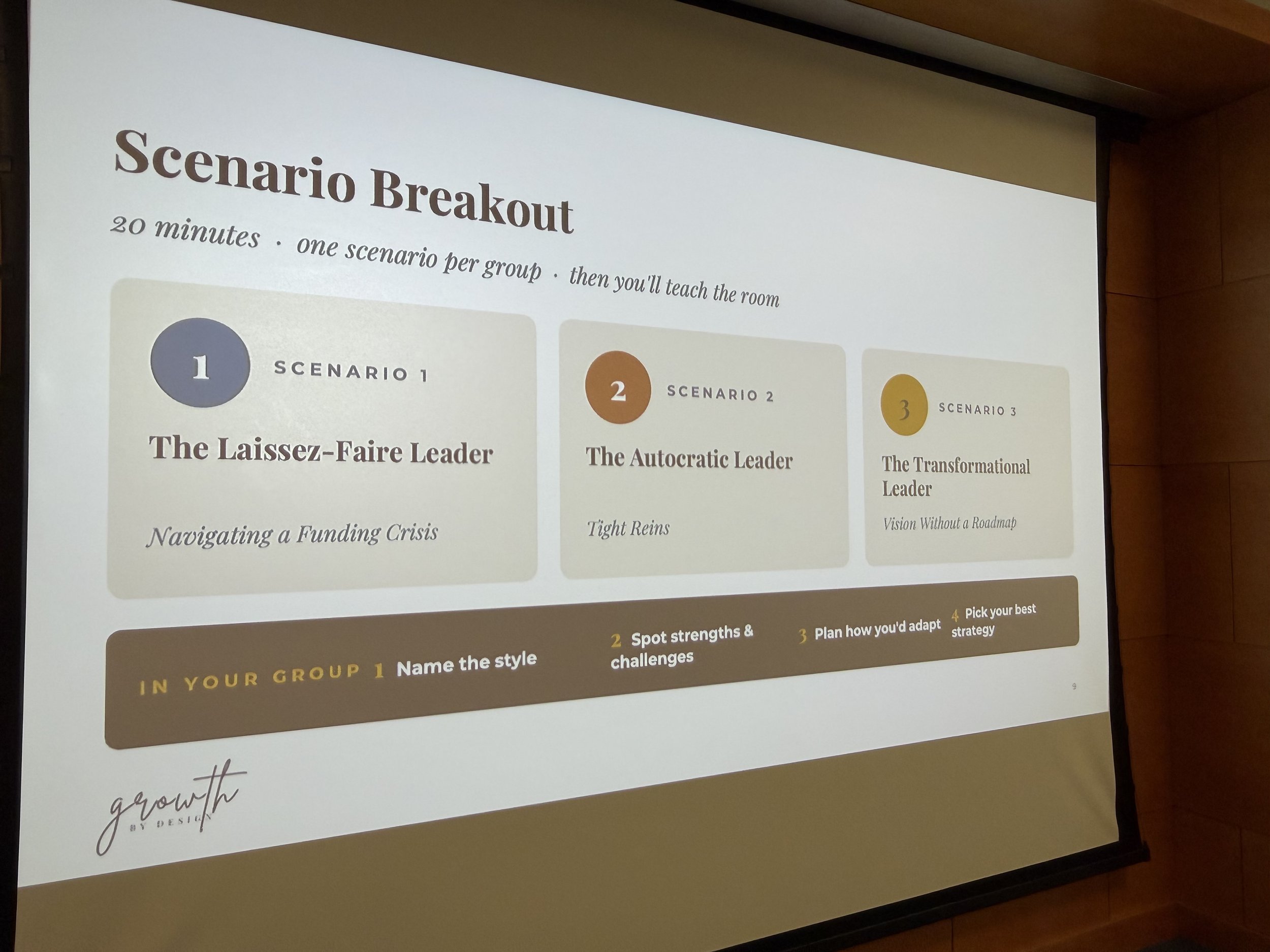
Each group took one leader, named the style, spotted its strengths and challenges, planned how they'd adapt, and then taught the room.
Three leaders you've probably worked for
Every style has real strengths. Every style also creates predictable pressure points for the people raising money. Here's how the three we explored show up in major and planned giving.
The hands-off leader (laissez-faire). This leader trusts you. You have room to build donor relationships your way, test new ideas and own your results. Strong fundraisers often thrive here. The pressure point comes in a crisis. In our scenario, a well-liked CEO goes quiet while a major funding source is in jeopardy and local headlines are asking questions. Donors want answers, and the development team is left deciding alone how much candor is too much.
Your move: Don't wait for direction. Draft the talking points yourself and ask for a quick yes.
The tight-reins leader (autocratic). This leader brings speed, clarity and confidence, and boards often love it. Decisions get made. Messaging is consistent. In our scenario, a new executive director requires approval on every donor letter, invitation and thank-you call. Materials look polished. But fundraisers lose the personal touches that built trust over years, and some donors start to notice their conversations feel scripted. Short-term results can hold while the long-term pipeline quietly thins.
Your move: Earn trust in small, visible ways, like a polished donor report or a well-run visit, until responsibility can be shared.
The visionary leader (transformational). This leader paints a future people want to be part of. Staff feel energized. Donors feel like partners in something bigger. This is the style most connected to transformational, multi-year gifts. It's also the leader from the opening: a bold $10 million vision with no budget breakdown, no plan for how the money will be used and no vetted talking points.
Your move: Become the person who turns the vision into a plan donors can believe in.
Why the visionary leader got the room talking
The transformational scenario struck a nerve because it puts the fundraiser's credibility on the line. The vision is real and the momentum is real. But the donor across the table will ask, "What will my gift actually do?" If you can't answer honestly, it's your relationship that pays the price, not the CEO's.
That tension echoed through the whole conference. Session after session came back to two themes. The first was emotional resonance: helping donors see themselves in your work, not just admire it from a distance. The second was trust, and how much it has worn down as AI-generated messages and bots fill people's inboxes.
Those two themes belong together. Donors are more skeptical than ever of anything that sounds polished but hollow. A big, inspiring vision without substance behind it now reads as one more pitch. A vision backed by a clear plan, honest answers and a real person who knows the details is exactly what cuts through.
I learned this lesson long before I worked in fundraising. When I was a career counselor in the Navy, my command master chief was responsible for the well-being of every sailor in the squadron. When a new sailor checked in, we'd talk about their next three years: Did they want to advance? Learn a new skill? Where was their career headed?
And every time a sailor said, "I hope to...," my master chief would stop them. "Hope is not a plan. What do you plan to do? What are your action steps?" He believed it so deeply that he once asked me to paint "Hope is not a plan" above the doors leading into the squadron.
I'll admit I found it a little amusing at the time. I'm an incredibly optimistic person. Optimism, abundance and believing in what's possible are core to who I am. But he was right. Hope is inspiring. It energizes people and gets them excited about the future. Without a plan behind it, though, hope can do as much damage as having no hope at all, because people commit to something that can't deliver.
That's the visionary leader's trap. The answer isn't less vision. It's vision with a roadmap, delivered by people donors trust.
When loyalty and integrity pull in different directions
Several of the questions after the session were some version of this: "What do I do when what my organization wants me to say isn't quite what I can honestly say?"
It's a fair question, and fundraisers face it more often than we admit. You care about the mission. You want to support your leader. And you're also the person whose name is on the relationship with the donor.
Here's how I think about it. Loyalty to your organization and integrity with your donors aren't actually opposites. Your organization's long-term health depends on donors trusting it, and that trust runs through you. Protecting your integrity is an act of loyalty to the mission, even when it feels like friction with your leader.
In practice, that sounds like:
Telling donors what's decided and what's still in development, plainly
Going back to leadership with specific asks: a case statement, a budget, three approved talking points
Framing your pushback around donor trust and the campaign's success, not your discomfort
Knowing your own line before you're standing on it
Every plan is carried out by people
This is the part I care about most, and it's why coaching is built into every Growth By Design engagement.
We write strong fundraising plans: clear goals, realistic timelines, the right donor strategies for each organization. But no plan raises a dollar on its own. Real people carry it out, and every one of them is working through something. A new executive director is still finding their footing. A board chair is juggling a demanding day job. A development director is quietly wondering whether she can be honest with her CEO.
So alongside the strategy, we coach the people. We help leaders understand their own style and how it lands on their team. We help fundraisers navigate the conversations they're dreading. We help boards see where they genuinely fit. When the human side is supported, the plan actually gets executed, and that's where the results come from.
Take the scenarios back to your team
The best part of this session is what happens when a team works the scenarios together. People start naming patterns they've been living with for years, and they leave with strategies they can use on Monday.
The companion handout walks through all three leadership styles, their strengths and pressure points for fundraising, and the discussion questions from each scenario. Download it here and use it at your next team or board meeting.
And if you'd like help with the strategy and the people who will carry it out, let's talk.
P.S. While at the conference, I also recorded six new episodes of A Legacy of Generosity with leaders in gift planning. Watch for them in the coming weeks.